Theta One at ACL 2025, on the Front Lines of AI Research
Theta One AI, which dreams of transforming education with multimodal AI, attended ACL 2025, one of the leading international conferences in natural language processing.
With 8,360 papers submitted from around the world, the conference made the enthusiasm for AI impossible to miss. Here are reflections from Gio, who leads Theta One AI's multimodal AI research and development.
Before we begin, here is a paper Gio coauthored! ✨
MMRefine: Unveiling the Obstacles to Robust Refinement in Multimodal Large Language Models
Paik et al., Findings of the Association for Computational Linguistics, 2025
Hello! I'm Gio, an ML engineer responsible for speech AI research and development at Theta One. 😎
I attended ACL 2025 in Vienna, Austria, from July 27 to August 1. It was a meaningful chance to learn about research from around the world and talk with researchers in person. Here is a short account in four parts:
- What is ACL?
- Papers at ACL 2025
- Poster presentation
- Beyond ACL 2025
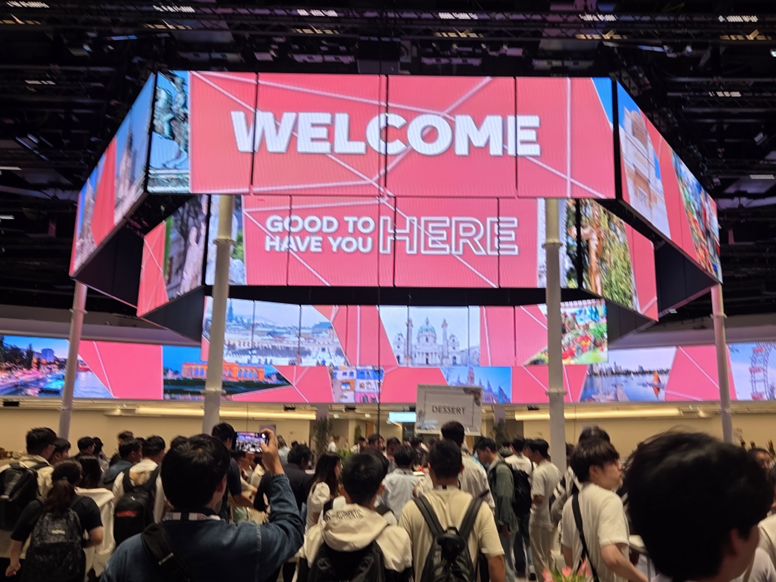
🤔 What is ACL?
ACL stands for the Annual Meeting of the Association for Computational Linguistics. As the name suggests, researchers who study language with computers gather to share results and ideas. It is one of the world's largest AI conferences, covering natural language processing (NLP), including systems such as GPT and Gemini, as well as search, translation, sentiment analysis, and many other intersections of computing and language.
With so many submissions, selecting papers is rigorous. Papers pass through peer review by two to four reviewers of anonymous submissions, a meta-review that considers the reviews and authors' additional experiments, and a final decision on whether the work should be presented at ACL. Only accepted papers are presented during the three-day main conference.
Around the main event, tutorials by leading researchers, invited talks, and networking events offered opportunities to encounter research beyond speech AI. In the last two days, workshops on speech recognition and AI for education let specialists exchange ideas in depth. They were also a useful chance to reconsider Theta One AI's research direction.
📜 Papers at ACL 2025
As interest in AI has surged, 8,360 papers were submitted to ACL this year and 3,091 were accepted (20.3% to the main conference and 16.7% to Findings). That was a 70% increase over the previous year. Among accepted papers, 51% had a first author from China, 18.6% from the United States, and 3.4% from Korea. Yes, Korea was third!
The largest areas were NLP Applications (13.1%) and Resources and Evaluation (12.4%), followed by Multimodality and Language Grounding and Efficient Low-Resource Methods.
After five days of poster and oral sessions, these papers stayed with me:
Multimodal research
LLaMA-Omni2: LLM-based Real-time Spoken Chatbot with Autoregressive Streaming Speech Synthesis
This paper clearly explains how to add a speech encoder, adapter, and voice decoder to the open-source Qwen2.5 LLM to create a speech-in, speech-out model. I'll remember it if we take on a speech language model in earnest.
Centurio: On Drivers of Multilingual Ability of Large Vision-Language Models
An analysis of multilingual performance in large vision-language models.
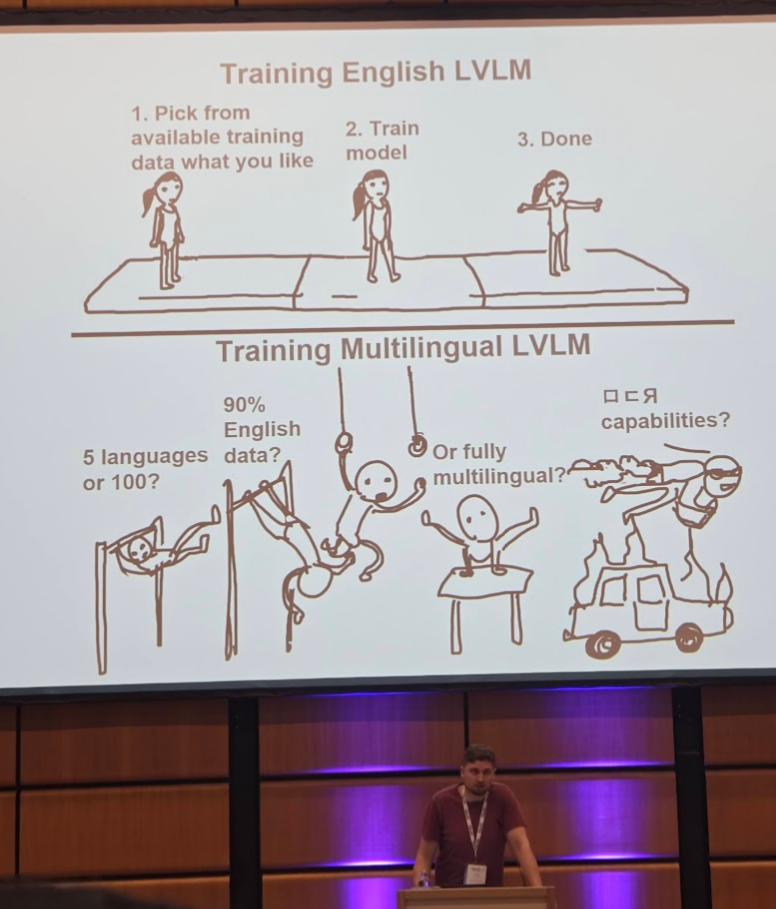
Among its useful findings: for multilingual training, allocate 50% of data to English and distribute the rest evenly among other languages; for OCR, more multilingual data helps recognition of non-Latin scripts. I still wonder whether expecting native OCR ability from today's vision-language model architecture is the right approach.
From English to Second Language Mastery: Enhancing LLMs with Cross-Lingual Continued Instruction Tuning
The authors argue that tuning on translated instruction data during supervised fine-tuning is enough to teach a model a new language. Drawing on Chomsky's principles and parameters theory, they compare continued instruction tuning, analogous to learning principles in one's native language before learning a foreign language's parameters, against mixing English and foreign-language data from the start. I wonder whether the result extends to speech models.
Code-Switching Curriculum Learning for Multilingual Transfer to LLMs
This takes a related approach using code-switching. The curriculum begins by replacing a few training tokens with words from the target language, then progresses from token-level code-switching to sentence-level code-switching and finally target-language-only text. The authors report improved performance in the target language.
ASR
Hypernetworks for Personalizing ASR to Atypical Speech
Rather than fine-tuning a separate model for each person with atypical speech, for example speech affected by Parkinson's disease, the authors train a hypernetwork that generates personalized weights. From a service perspective, precomputing and storing only each user's weights seems attractive.
SIFT-50M: A Large-Scale Multilingual Dataset for Speech Instruction Fine-Tuning
Amazon's 14,000-hour speech dataset covers five languages: English, French, German, Spanish, and Italian. It is disappointing that all five are Western languages, but speech datasets are so scarce that this one was quickly put to use.
DNCASR: End-to-end Training for Speaker-attributed ASR
This end-to-end model trains and performs speaker clustering and speech recognition together. As someone developing speech-to-text systems, I was glad to see it.
Distilling an End-to-End Voice Assistant Without Instruction Training Data
The title is provocative, but the method still needs speech data. What it avoids is paired speech instructions and correct answers: it transcribes speech instructions, uses an LLM response as the target signal, and trains from there. If the language model already has sufficient knowledge and only needs to adapt to speech as a new modality, this seems like a reasonable way to reduce the need for high-quality answer labels.
Low-resource languages
There was a lot of work on languages from India, the Middle East, and Asia. We also have less well-organized data than one might think, so many of these papers caught my attention.
- IndicSynth: A Large-Scale Multilingual Synthetic Speech Dataset for Low-Resource Indian Languages
- A-TASC: Asian TED-Based Automatic Subtitling Corpus
- GigaSpeech 2: An Evolving, Large-Scale and Multi-domain ASR Corpus for Low-Resource Languages with Automated Crawling, Transcription and Refinement
- LLäMmlein: Transparent, Compact and Competitive German-Only Language Models from Scratch
It was refreshing to see a model trained only on German in a world where mixing predominantly English data with other languages has become almost a rule. If all data were equal, how much would the training language itself matter? - HyperOFA: Expanding LLM Vocabulary to New Languages via Hypernetwork-Based Embedding Initialization
Other work
Here are some papers outside my direct research area that I found interesting.
- Value Portrait: Assessing Language Models' Values through Psychometrically and Ecologically Valid Items
Not quite an "AI MBTI": it classifies AI values using psychological theory. A model's apparent personality changes with prompts and context, so what determines its character without either? - Curriculum Debiasing: Toward Robust Parameter Efficient Fine-Tuning Against Dataset Biases
- Understanding Silent Data Corruption in LLM Training
As presented, the issue involves a model failing to return an end signal and continuing to occupy hardware, somewhat reminiscent of Gemini's recent self-critical loop. Even one problematic sample in a batch can stall a pipeline and waste training time. The paper examines this problem in depth. - Learning to Insert [PAUSE] Tokens for Better Reasoning
Since o1, researchers have tried adding special tokens during reasoning, sometimes at positions chosen manually. This paper uses log likelihood to insert them automatically during training. The approach looked simple and effective.
The talks also raised broader questions worth revisiting:
- Alignment
Are LLM development and evaluation metrics aligned with what people want and what benefits them? An invited talk took this seriously. GPT-5 had just launched and scored much better on benchmarks, yet some users described its responses as less human or less warm than GPT-4o's. That tension deserves thought. - Tokenizer-free language models
An invited speaker observed that we tend to accept tokenizers as just how things work, and I had to agree. Korean users pay a several-fold efficiency penalty compared with English, yet even we rarely question it. Research on tokenizer-free models is advancing, and growing interest in continuous tokens in multimodal AI suggests it may not be a distant idea. - Mixture of Experts
The idea has been around for a long time but is only now becoming an industry standard. It is intuitive and powerful, though its space complexity is awkward, especially from a product-development perspective.Would it feel easier if we had a B200 GPU?
Even this selective list is long! Including the papers I did not share, I have at least 50 to read. Many papers now appear online without a conference visit, but meeting researchers from around the world, discussing their work, and sharing ideas in person was still deeply enjoyable and inspiring.
I found ideas that could help Theta One's speech-recognition products and English-learning services now, as well as ideas for a longer-term roadmap. It was also an opportunity to expand our network at home and abroad.
🍀 Poster presentation
Reading papers and eating schnitzel were not the only reasons I flew to the other side of the world. On day three, I gave a 90-minute poster presentation!
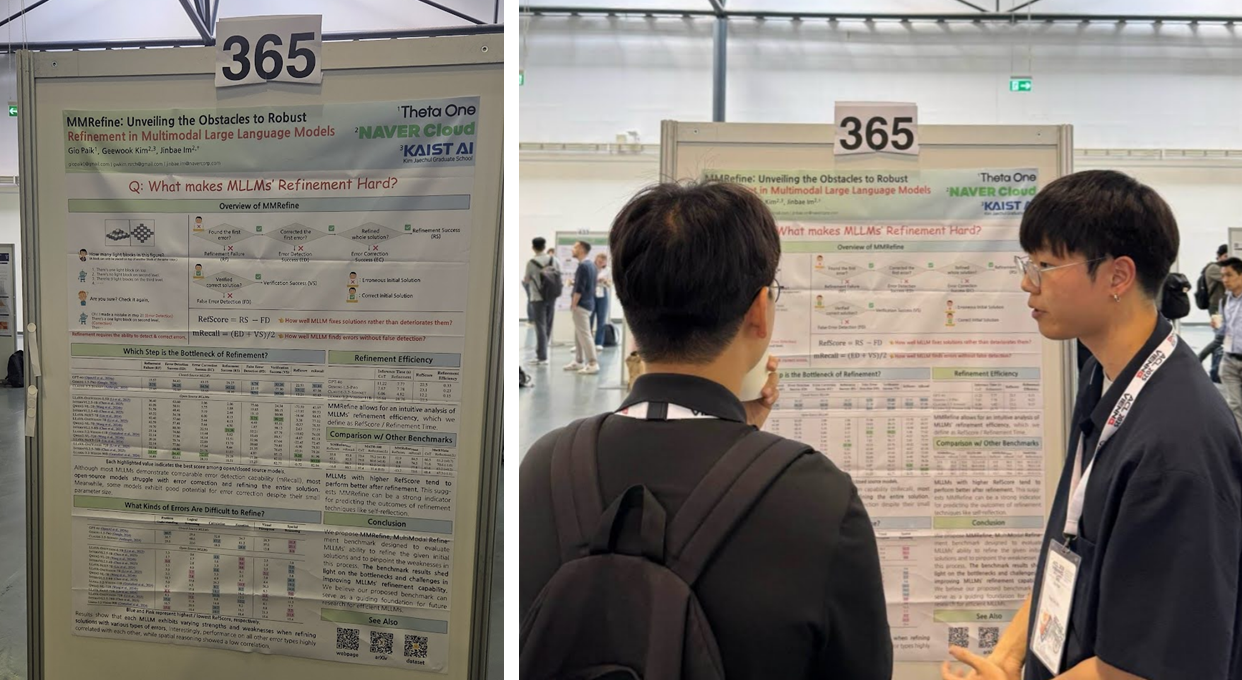
Our paper, MMRefine: Unveiling the Obstacles to Robust Refinement in Multimodal Large Language Models, proposes a benchmark to analyze and evaluate multimodal language models' ability to improve their own reasoning. Researchers showed considerable interest in a benchmark that reveals refinement potential beyond simple accuracy comparisons.
Theta One develops LLM and speech-recognition services and studies multimodal language models. When visitors asked, "What does Theta One do?" I was reminded that strong, meaningful research is one way to build awareness of our work.
🚀 Beyond ACL 2025
Attending five days of a conference on this scale brought home the gap between big tech and academia. The difference in resources has shaped research topics for years. Meanwhile, debt is accumulating in difficult-to-evaluate areas such as alignment and generalization, and scaling can push other problems, including tokenization, out of focus. Many researchers recognize these issues, but clear solutions remain elusive.
Beyond academic concerns, looking at large companies, small startups, and industry-track research also made me think as a Theta One ML engineer:
What kind of AI should a startup pursue and build?
What defines the role of an ML engineer, a profession less than a decade old?
Neither my company nor the conference offered a simple answer. But an engineer's fundamental task still seems clear:
Define the problem well and make technology solve it.
Theta One AI uses AI to address problems in how we learn, communicate, and enjoy life.
We will keep building good things: good services, useful open source, and excellent research.
Stay tuned for what Theta One AI does next!
